
For those of us who tow, a trailer hitch is essential. Without a hitch, you can’t safely connect your trailer to your towing vehicle. But trailer hitches fall into different classes, so it’s important to know the differences between them to pick the right one for your next towing job.
Trailer hitch class: how to choose the right one
What are trailer hitch classes?
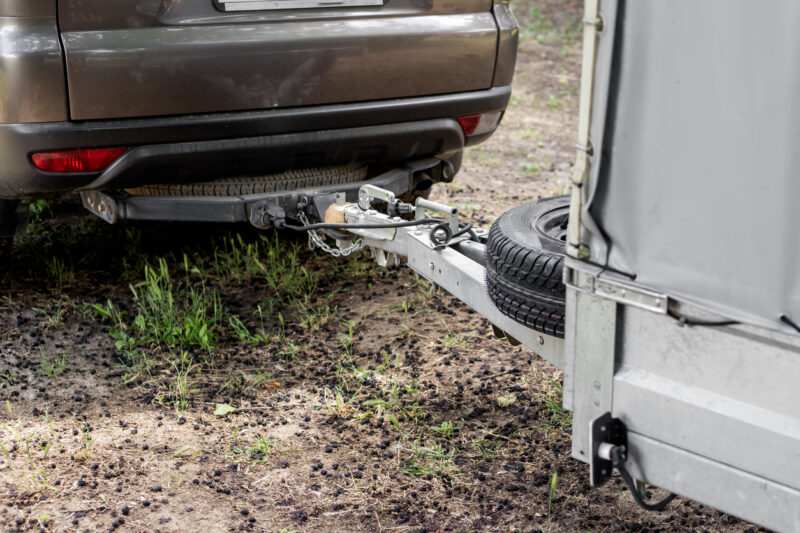
There are five trailer hitch classes: I, II, III, IV, and V. Each class has a maximum weight capacity and a standard size for the hitch receiver opening. The higher the class number, the higher the towing capacity and the larger the receiver tube. The classes also have a maximum trailer tongue weight, which is the amount of downward force the trailer tongue places on the hitch.
A trailer hitch may be weight carrying or weight distributing. With a weight-carrying hitch, the weight being towed is placed primarily on the hitch and the rear of the tow vehicle. A weight-distributing hitch, however, spreads the weight across the trailer tongue and the tow vehicle’s front axis.
Keep in mind, most hitches are vehicle specific, so not every hitch class can be paired with every vehicle.
Class I
Class I trailer hitches are typically used with passenger cars and small crossovers. Made for light–duty use, these weight-carrying hitches have a 1.25in. receiver opening and allow a vehicle to tow up to 2,000 lb. The maximum trailer tongue weight for a Class I trailer hitch is 200 lb.
Class II
Designed for moderate-duty towing, a Class II trailer hitch is typically used with passenger cars, crossovers, and minivans. This hitch is weight carrying and has a 1.25in. receiver opening and can usually tow up to 3,500 lb. Class II hitches have a maximum trailer tongue weight of 300 lb.
Class III
Class III hitches are used with crossovers, full–size SUVs, vans, and trucks. They may be weight carrying or weight distributing. Weight–carrying Class III hitches usually tow up to 6,000 lb with a maximum trailer tongue weight of 600 lb. A weight–distributing Class III hitch can tow up to 10,000 lb with a maximum trailer tongue weight of 1,000 lb. All Class III hitches have a 2in. receiver opening.
Class IV
Class IV trailer hitches are used for heavy–duty applications and they’re usually paired with large pickups and full–size SUVs. These hitches have a 2in. receiver opening, and they may be weight carrying or weight distributing. A weight–carrying Class IV hitch tows up to 10,000 lb and accommodates a maximum trailer tongue weight of 1,000 lb. Weight–distributing Class IV hitches usually pull up to 14,000 lb with a maximum trailer tongue weight of 1,400 lb.
Class V
Class V hitches are needed for those superheavy loads. They’re often used with large pickups and full–size SUVs. They have a 2.5in. receiver opening and can be weight carrying or weight distributing. Weight-carrying hitches in this class generally tow up to 12,000 lb with a trailer tongue weight of 1,200 lb. Weight-distributing Class V hitches can pull up to 17,000 lb with a trailer tongue weight of 1,700 lb.
Which hitch?
For safe towing, choose the hitch class that best suits your needs. This means determining how much weight you’ll be towing and what vehicle will be pulling the load. Check out this article for information on calculating important towing figures.
We have a wide range of trailer hitches available on NAPACanada.com. To make sure the parts you choose will fit, enter your vehicle’s details under the “Select a vehicle” button on the website.
Don’t forget to keep your trailer in good condition, too. Learn how to maintain what you tow with this guide. Make sure you’ve got the right towing accessories, too.
For routine maintenance and repairs, trust the professionals at a NAPA AUTOPRO service centre. For more information on trailer hitch classes, chat with an expert at your local NAPA AUTO PARTS store.
 Author:
 No comments