

When your car won’t start, it’s reasonable to blame it on the battery. However, what if your alternator or starter is the cause? Let’s review the differences between starter, alternator, and battery problems to help you make quick work of the diagnosis and repair so you can get back on the road.
How to Diagnose Starter and Alternator Problems
The Basics of Your Vehicle’s Electrical System
When you turn the key or press the start button, the starter solenoid engages the starter motor, which uses battery power to crank the engine. Once the engine is running, it drives the alternator through a belt. The alternator—working with the voltage regulator—recharges the battery and supplies power to your vehicle’s electrical systems.
How the Starter Works
The starter is an electrical motor with a small gear—a pinion—that engages the flywheel to crank the engine. When you insert your key/press the start button, the starter draws heavy current from the battery to get that engine humming. It usually lasts about 160,000–240,000 km.
Because your starter draws so much power and generates significant heat, limit each cranking attempt to 10 seconds. If the engine doesn’t start after the first attempt, wait at least 30 seconds before trying again. After three failed attempts, stop and diagnose the problem to avoid damaging the starter.
Signs Your Starter Is Failing
If your engine doesn’t turn when you’re trying to start it, you may have loose or corroded connections, a faulty or discharged battery, or a loose starter pinion or flywheel ring gear.
If your starter is noisy, the starter pinion, flywheel ring gear, or starter mounting bolts may be loose. This symptom can also indicate a discharged battery or a worn starter.
If your starter turns the engine slowly, you may have a discharged battery, or loose or corroded battery terminals.
However, if you smell smoke or something burning, or if you hear grinding, stop immediately. The starter may be overheating, or the starter gear isn’t meshing properly with the flywheel. Both can damage your starter.
How the Alternator Works
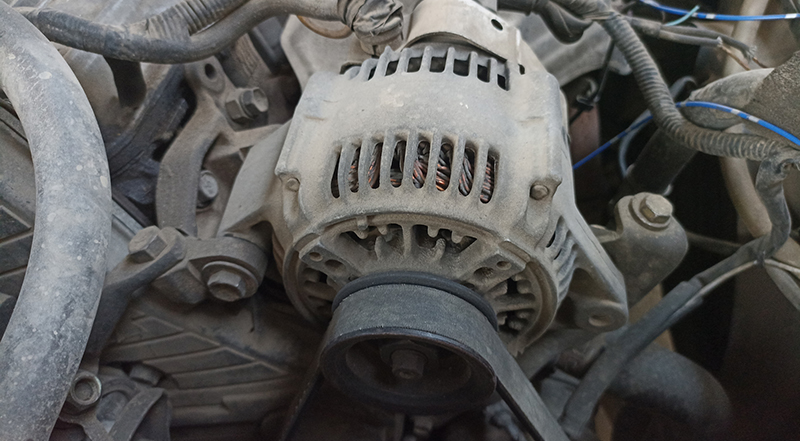
The alternator turns the mechanical energy generated by the engine into electrical energy needed to power your vehicle. Its good friend is the voltage regulator, which helps ensure that the flow of electricity matches your vehicle’s needs.
An alternator’s normal output is 13.5–14.5 V, and it typically lasts 7–10 years or 80,000–150,000 km.
If you continue driving with a bad alternator, you can damage crucial electrical components like the water pump, power steering, and fuel pump. A weak alternator can also stall your engine, which can be very dangerous if you’re driving at high speeds or in heavy traffic.
Signs Your Alternator Is Failing
Some common symptoms of a bad alternator include:
- frequent stalling or trouble starting
- growling or squealing noise
- dim or overly bright lights
- battery warning light on
- burning rubber smell
- electrical accessories acting erratically
Some of these symptoms are similar to the symptoms of a dead battery, so a thorough diagnosis is imperative.
Diagnosing Electrical System Problems
When your car won’t start, always test the battery first. It’s the most common failure point and the easiest to diagnose.
Test Your Battery
With the engine off, use a multimeter or battery tester to check the battery voltage. A fully charged automotive batteryshould read 12.6 V or higher. If your battery shows 12.4 V or less when the engine is off, charge it with a battery charger before continuing your diagnosis.
Voltage at rest doesn’t tell the whole story, because a battery can fail under the load of starting your engine. Therefore, still continue on to the alternator if your battery passes these basic tests.
Test Your Alternator
Inspect the serpentine belt for proper tension and any visual damage.
Next, start your engine and use a multimeter to measure the voltage at your battery terminals. A normal reading is between 13.5 and 14.5 volts. Rev the engine to around 2,000 RPM and check again. The reading should remain steady in this range.
Be cautious in these two scenarios:
- Under 13.5 V means your alternator isn’t charging the battery.
- Over 15 V suggests an overcharging problem and points to the voltage regulator.
Check Your Starter
If your battery tests good and your alternator is charging properly, but your car still won’t start, the starter may be the problem.
Begin with a visual inspection, looking for loose or corroded connections at the starter and battery. Check for any damaged or frayed wires.
When you turn the key, listen carefully to the sounds your vehicle makes.
- A single loud click typically indicates the starter solenoid is engaging, but the motor isn’t turning.
- Rapid clicking usually points to insufficient power from the battery or poor connections.
- A grinding noise means the starter gear isn’t meshing properly with the flywheel. (If you hear this, stop immediately to avoid damaging your flywheel.)
Testing starter current draw requires specialized equipment and is best left to professionals at your local NAPA AUTOPRO service centre.
For any other questions, visit your local NAPA Auto Parts store, where one of our knowledgeable staff will be happy to assist.
 Author:
 3 Comments


I think the admin of this web site is genuinely working
hard in support of his website, as here every material is quality based material.
Also visit my homepage: Where To Get Cheap Car Batteries, http://Mnogo.Ru/,
I read this paragraph completely on the topic of the resemblance of latest and
earlier technologies, it’s amazing article.
I got this web page from my pal who told me regarding this
website and now this time I am browsing this web page and
reading very informative content at this time.