

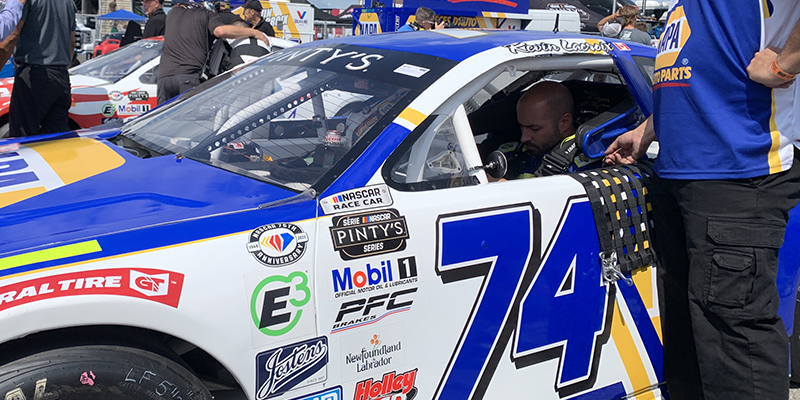
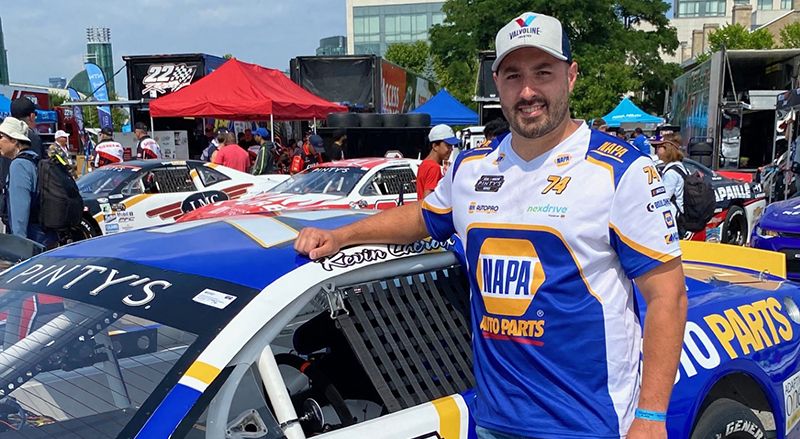
Since last year, NAPA has had the honour of having its colours on NASCAR Pinty’s Series car 74, driven by Kevin Lacroix. A four-time runner-up in the series since 2015, the Saint-Eustache native started racing in 1996, at the age of 7, in karting. To find out more about the 34-year-old driver, NAPA had the opportunity to talk to the co-owner of the Lacroix NAPA Auto Parts stores about his passion for the sport.
Meet NASCAR Pinty’s Series Driver Kevin Lacroix

NAPA: What are your earliest memories of motor racing?
Kevin Lacroix: My father raced snowmobiles. I remember when I was very young – I want to say 2 or 3 years old … maybe that’s not possible – but at a very, very early age, I attended my father’s snowmobile races. Those are my first memories of competitive racing.
Apart from that, it was Jacques Villeneuve’s first year in Formula 1, in 1996. I was 7, and I already knew about him. I’d already followed him a bit, and I couldn’t wait for his first year in Formula 1. I remember watching almost all of his races.
NAPA: So, you remember seeing him at the special event at the Forum when he won the championship?
KL: Yes, exactly. I was definitely up early to see his World Championship final in 1997. I didn’t miss it, that’s for sure.
NAPA: When you’re in your first race as a young driver, what emotions do you go through?
KL: I definitely remember the first few races. I think in my first race, I was more focused on imitating the TV commentator in my head than running my own race. I was commenting on myself; I saw myself in Jacques Villeneuve’s place in Formula 1. Of course, when you think about it, that’s what kids do: they do things that are kind of hard to believe. I think that’s why we do things like that: it’s passion. Car racing was a passion from an early age, and my first few races were really special for me.
NAPA: Speaking of Jacques Villeneuve, can you see yourself in Formula 1?
KL: Definitely not. Of course, at my age now, it’s a bit too late. By a certain age, your career is set in a certain direction. When I was quite young, because of Jacques Villeneuve, I saw myself in Formula 1. As I grew older, my goals had changed. When I was maybe 13 or 14, I saw myself in the United States in other competitive series – Indy Car, for example. Your tastes change as you get older, but it’s always been motorsport since I was young.
NAPA: You went from Formula Kart to Formula BMW, Formula Star Mazda and Formula Atlantic before joining NASCAR. What made you switch from one formula to another in such a short time?
KL: Actually, that’s the logical progression if you’re going in a specific direction. I was heading for Indy Car. I really went through all the stages to go in that direction. Those were the most competitive stages […] for the age groups I was in at the time.
…
NAPA: We know that Alexandre Tagliani was one of your racing teachers. Do you still keep in touch with him?
KL: We certainly share memories. We talk a lot outside the races. We definitely talk to each other about the races, but outside the races, we shared stories from our past. We’re real enthusiasts. And what else are two racing guys going to do but talk about
NAPA: … talk about racing and their dreams (laughs). In 2008, you took a seven-year break. Why did you stop? And how important was it for you?
KL: Actually, it was a difficult time because 2008 was my last season. At the time, I really thought I’d achieved my goal: we’d signed a contract for Formula Atlantic, which is the equivalent of today’s Formula 2, and then a two-season contract with Indy Car for the following years. That had been my goal for a long time, so I was really happy. Then, in mid-2008, there was a big economic crash.
Personally, I was being sponsored by an investment company, and that was a bad time for any investment company. Then the team I had a contract with folded; it was one of the top three teams and it folded. Honestly, what are the odds of that happening?
But from 2009 onwards, all the teams changed. It would have been easy to make new contacts with other teams, but at the time, everyone was looking for money, and that’s something we didn’t have. I based my career on my talent and not much money, and I managed to persuade the team bosses to let me race anyway. But when money became a bigger issue, I had no choice but to stop.
The fields shrank from about 30 cars to 5 or 6. A number of drivers were in the same situation as me. In 2011, things were starting to get a little better, but it’s hard to come back after a three-year hiatus. At the same time, it forces you to make another career choice, perhaps forget about the dream and move on to the slightly more serious life of working and earning a living.
NAPA: What happened to you during those years off?
KL: I turned to my second career, which is the auto parts stores we have with the family. I focused on that with my brother. We worked hard in the business to grow it over the years. That was my second career. In the years up to 2015, when I wasn’t racing at all, I developed a great interest in the business, and I worked hard.
NAPA: What brought you back to racing?
KL: Actually, we have a family friend with a shared passion. He’s the owner of Excellence Chrysler in Saint-Eustache, and he races in series that are a bit less competitive, and he used to have his son drive. At one point, his son couldn’t make the race, so he called me, and I ended up winning the race. I got the bug again, and that’s what convinced him. The passion has really returned.
We were looking for a competitive local competition series with no travel. It’s funny because that year, we were looking to buy either a family cottage or a racing team, and we chose the racing team. We split the cost of the equipment 50-50, and we said we’d do four races a year. But I won two of the four races in my rookie season. That’s when a sponsor approached us about doing the whole year. That was in 2015. So, in 2016, we did the full season. We’ve been able to find several sponsors over the years.
NAPA: How do you prepare for the races? Do you have a ritual?
KL: I don’t really have a ritual, but before each race, I’ll watch the re-run of the previous year’s race on the same track to see how it went and try to get back into it. Every track is different, and I try to see the strategies of the other drivers, to see what others that’s have done paid off and what’s been less successful.
NAPA: As a driver, do you have to have a lifestyle, diet, etc.?
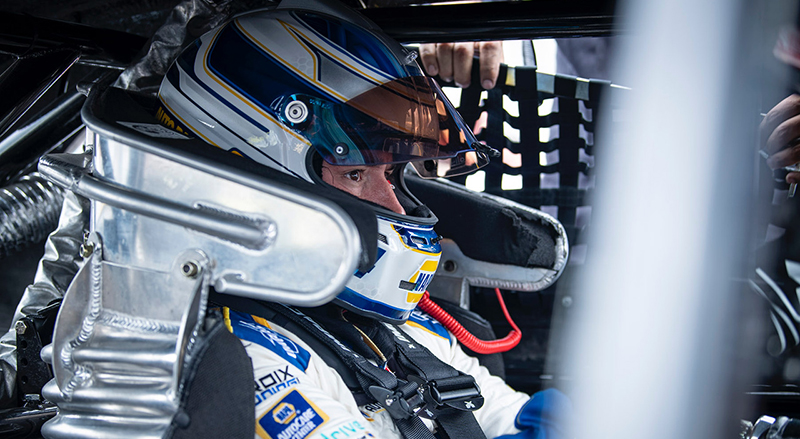
KL: If there was a bible of recommended things for being a driver, there would be, yes, but that’s not me (laughs). Formula 1 is hard on the heart and the muscles, and there’s the dehydration and concentration. NASCAR cars are much easier to drive. The only thing is that the heat in the car is awful. So, you get really dehydrated, and it’s hard to concentrate. It’s not really the physical effort, more the mental effort.
In fact, that’s what happened in the race in Toronto. I was on my way to victory, but it was one of the three hottest races I’ve ever been in. That’s probably why Alex Tagliani won, and he slowed down a lot in the final laps. It would have been an easy opportunity for a win, but I was so anxious for the race to be over that I wasn’t going flat out until the end. So that sort of casts doubts on the good old driver’s bible … I might have to reread it … (laughs).
NAPA: Do you always do a post-mortem on the race with your team?
KL: Yes, every weekend. As a group, we have a lot of experience, but each event is unique; we make mistakes every weekend, and it’s important to review and learn from our mistakes. Elsewhere, like in the States, they do, like, 35 races. We do 15 a year, so each race is more important to learn from and look back at everything we did.
NAPA: What would be your greatest career moment to date?
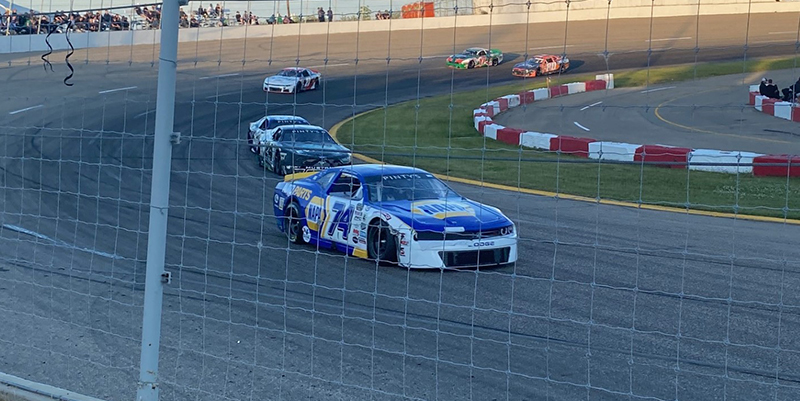
KL: In 2015, I won the Trois-Rivières Grand Prix. That year, we ran only four races, and we did it for the fun of it. I knew I had talent when I was younger, but I was away from it for eight years. And in our series, Andrew Ranger and Alex Tagliani have raced internationally; they’re high-calibre drivers. I didn’t expect to win, and at the time, I didn’t know I could win against those people. It’s the second biggest Grand Prix in Canada, after the Montreal Formula 1 Grand Prix, so it’s a big deal. It’s the Grand Prix that everyone wants to win every year, and to go there and win it in my first year was really special for me; it was really great.
NAPA: We hope you win it this year.
KL: I won it the first two times, in 2015 and 2016, and I’ve had bad luck every year since. We’re due. [ADDENDUM: Unfortunately, Kevin Lacroix had to pull out of this year’s race after a brake problem caused him an accident.]
NAPA: Was there a particularly hard time?
KL: That was actually in 2009. All through 2008, I knew it was my last year. And then the reality hit me in 2009, but it wasn’t really during my career, because my career was over.
Now, every day we go racing is a good day. No matter how good or bad our results are, we’re still doing what we love.
NAPA: Let’s talk about your family. Have you talked about the danger of racing?
KL: Yes and no. When I was young, my parents let me do what I wanted. I won’t say they weren’t disappointed that I didn’t achieve my dream, but in truth, they were happy. Especially since the direction I was heading in, Indy Car, is the most dangerous competitive series. Of course, when I stopped, they were happy that I was no longer in danger.
Even though it’s been my biggest dream, I’ve physically been to races and I watch them on TV, but I wouldn’t go today, with my family and so on. But I think that in NASCAR, what we do in Canada is much safer; the cars are bigger, and they’re less dangerous. I don’t really have any fears: you can get injured, you can hurt yourself a bit, but it’s not a matter of life and death, I don’t think. I’m willing to take the risk of getting hurt, but when it comes to gambling with your life, I’d quit because families more important.
NAPA: How do you balance life as a racing driver with family life?
KL: Our competition series consists of 14 races, most of which last one day, so it’s easy to strike a balance. It gets difficult sometimes because we’re on the road a lot, and the summers aren’t very long in Quebec, and I’m gone. If you want a family vacation in the summer, the answer is no. We have no choice but to take it in February or something like that (laughs).
NAPA: Do you bring your family?
KL: My wife tries to come when she can, about half the time. As a treat for Mathis, his mother used to take him to two races a year: Trois-Rivières and Mirabel. But now, it’s for other reasons, because he’s starting kart racing. That’s often on the same weekends as me, unfortunately, so I miss his races and he miss mine. That’s really a shame, but he needs to have fun, too.
NAPA: How do you balance life as a racing driver with family life?
KL: Our competition series consists of 14 races, most of which last one day, so it’s easy to strike a balance. It gets difficult sometimes because we’re on the road a lot, and the summers aren’t very long in Quebec, and I’m gone. If you want a family vacation in the summer, the answer is no. We have no choice but to take it in February or something like that (laughs).
NAPA: Do you bring your family?
KL: My wife tries to come when she can, about half the time. As a treat for Mathis, his mother used to take him to two races a year: Trois-Rivières and Mirabel. But now, it’s for other reasons, because he’s starting kart racing. That’s often on the same weekends as me, unfortunately, so I miss his races and he miss mine. That’s really a shame, but he needs to have fun, too.
NAPA: What drives Kevin Lacroix? What keeps Kevin Lacroix going?
KL: Uh, I don’t know … (laughs). No, the main reason I keep going is that I haven’t won the championship yet. That’s number one. And number two is that, despite all the races I’ve won, every weekend when I get in the car, I wonder if I’ve lost my edge. Every weekend, every competition, I’m afraid it’s going to happen to me, and I think it’s that fear which drives me to prove to myself that I haven’t lost it, honestly.
NAPA: If we could wish something for you, what would it be? To win the 2023 championship?
KL: Every year, that’s the goal. I don’t need to win any more races, to be honest. We’ve won a lot. It’s really about winning the championship.
 Author:
 No comments